"You know the difference between a hockey mom and a pit bull? Lipstick." -Gov. Sarah Palin-


"The media are not above the daily test of any free institution." -Barry M. Goldwater-

"America's first interest must be to punish our enemies, then, if possible, please our friends." -Zell Miller-

"One single object...[will merit] the endless gratitude of the society: that of restraining the judges from usurping legislation." -President Thomas Jefferson-

"Don't get stuck on stupid!" -Lt. Gen. Russel Honore-

"Woe to those who call evil good and good evil, who put darkness for light and light for darkness, who put bitter for sweet and sweet for bitter." -Isaiah 5:20-


Petition For The FairTax


GOP Bloggers Blog Directory & Search engine Blog Sweet Blog Directory

Directory of Politics Blogs My Zimbio

Righty Blogs Of Virginia

Coalition For A Conservative Majority


A REASON TO TRY available from Barnes & Noble
A REASON TO TRY available from Borders
A REASON TO TRY available from Books-A-Million
A REASON TO TRY available from SeekBooks New Zealand
A REASON TO TRY available from SeekBooks Australia
A REASON TO TRY available from Chapters.indigo.ca Canada's Online Bookstore
A REASON TO TRY available from Amazon.com
A REASON TO TRY available from Amazon UK
A REASON TO TRY available from Amazon Canada
Showing posts with label irs. Show all posts

Monday, April 20, 2009

Missouri House Approves State Fair Tax Constitutional Amendment

I've been a proponent of the FairTax for a few years now. My faith in the FairTax has never waivered nor will it anytime soon. Although many on the left (and a few on the right) have worked to discredit the idea of the FairTax over the past few years, the movement is gaining momentum.

The lastest victory come from Missouri where the House of Representatives voted to approve of a state Constitutional Amendment that would give Missouri a state-level FairTax.

From Fair Tax Nation:

In a development of potential national significance, the Missouri House of Representatives, on April 16, 2009, sent a proposed amendment to the Missouri Constitution, HJR36, to the state Senate that, if enacted, would bring a state-level Fair Tax to Missouri.

The sponsor of the bill, Edgar G. Emery (R-Missouri District 126, Lamar), advised me yesterday he thinks the bill has a reasonable chance of passage in the state Senate. There is no definite time table yet there - the resolution has had its first reading. However the passage of the proposal in the state House has enhanced the profile of the bill in the state Senate.

If the state Senate approves, the measure will be submitted to the voters of the State in November 2010 without need for consideration by the Governor.

If approved by the voters, the measure would take effect on January 1, 2012, and Missouri would become the first laboratory in the United States - and perhaps the world - to test the macro-economic benefits of the Fair Tax.

New Jersey FairTax State Co-Director, engineer and business owner, Norm Simms, has stated frequently that his decisions on where to site production are sensitive to tax climate. If the state FairTax passes, businesses would be expected to seriously consider locating - or relocating - to Missouri.

Credit for the success of this bill goes to the Missouri FairTax volunteeers.


You can access Missouri HJR36 on-line here:

Missouri HJR36

There have been many efforts at tax reform over the past twenty years, but all of them failed to produce the desired results. Here are three end-goals that any tax reform plan must have in order to be viable:

1) The plan must remove from the IRS any power to intrude on the private lives of American citizens.
2) The plan must remove from the K Street lobbyists any power to influence Congressional votes.
3) The plan must not allow hidden taxes to be passed along to the consumer at any time.

There is only one tax reform plan that addresses all three of these end-goals:

THE FAIR TAX


Americans For Fair Taxation


Wednesday, April 15, 2009

Even the IRS Can See The Double Standard On Enforcement Of The Tax Code

Fiscal responsibility is one reason why we should be supporting all of the Tea Parites being held today. But personal responsibility isn't very far down the list of reasons to do so.

Tom Hamburger and Ralph Vartabedian of the Chicago Tribune have this to say:

The Treasury secretary, who oversees the IRS, didn't pay all his taxes. Neither did five other top nominees for the Obama administration, or their spouses.

Now, as Wednesday's tax deadline looms, some Americans are wondering why they should comply with the arcane requirements of the Internal Revenue Service when top administration officials failed to do the same. Even some IRS employees are upset at what they see as a double standard.

...

"Our members are upset and angry," said Colleen Kelley, president of the National Treasury Employees Union, referring to concern bubbling up within the IRS over unusually strict rules that can cost agents their jobs if they make a mistake.

In some cases, IRS employees have lost jobs for simply filing a late return or failing to report a few hundred dollars of interest income.


And yet, people like Timothy Geithner got rubberstamped right through the Senate. Do you believe you would get such gentle treatment if you failed to pay your taxes the way Geithner failed to do so?

Probably not:

Robert Schriebman, a California tax lawyer who has testified before Congress, said his clients are seething over the tough treatment they get from the IRS, while some in the president's Cabinet apparently were able to duck paying their taxes.

"Politically powerful people are less likely to get bothered by the IRS," Schriebman said. "It is more than a question of fairness. Not only is the IRS looking away from confronting influential people, the IRS is getting a lot tougher and nastier toward the little guy."


Which is one of several reasons why we need to scrap the current tax code and replace it with the Fair Tax as well as getting rid of the IRS altogether.

You can access the complete article on-line here:

IRS Workers See Double Standard On Tax Errors
Tom Hamburger and Ralph Vartabedian
Tribune Newspapers
April 15, 2009

Tuesday, February 3, 2009

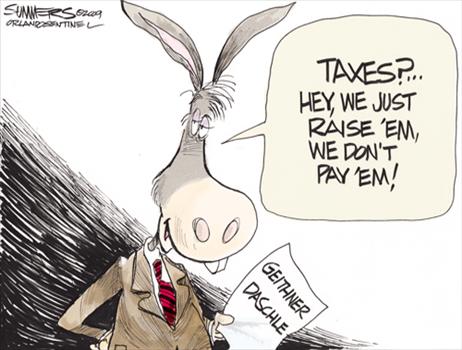
Taxes? Dems Want To Raise Them But Not Pay Them

If there is anyone out there who still thinks that the Democrats are some sort of paragon for ethics reform, please send me an email. There is a bridge in Brooklyn I'd like you to buy.

First Timothy Geithner and now Tom Daschle. What is it with Dems and their refusal to follow the same rules that Joe and Jane Average American have to follow? Why do the Democrats assume that they are somehow better than the rest of us and therefore don't have to abide by the same laws we do?

Daschle owed $128,203 dollars in back taxes and was working on avoiding having to pay them.

Writing for Town Hall, Kevin Freking has the following:

Tom Daschle's former Democratic colleagues were rallying to his defense after he met behind closed doors with the Senate Finance Committee to discuss problems with back taxes and potential conflicts of interest, but lawmakers promised he will face more questions.


The Dems are rallying to his defense, but would they have done the same thing if Daschle were a Republican? No. That would require integrity.

More:

Those questions will focus on tax issues, such as the $128,203 in back taxes and $11,964 in interest that he paid last month, said the aide. Daschle will also be questioned about the potential conflicts of interests he would face because he accepted speaking fees from health care interests, said the aide, who asked not to be identified because the aide was not authorized to speak publicly on the matter.

Daschle also provided advice to health insurers and hospitals through his work at a law firm.

Daschle began the day apologizing for his failure to fully pay his taxes from 2005 through 2007. He capped it off that way as well after meeting with the committee behind closed doors.


Once again, the Dems have shown us the hypocrisy that dominates thier logic. They have one very low standard for themselves and one very high standard for everyone else. People are beginning to notice.

But it won't matter. The Dems are not in the habit of listening to the American people. They simply go their own way regardless of how unethical or illegal their actions are.

The parting shot:

Melanie Sloan, the executive director of Citizens for Responsibility and Ethics in Washington, noted the Geithner nomination in saying she suspected tax problems would not prevent Daschle from becoming the next health secretary.

"If the guy who is overseeing the IRS can get away with a tax problem, how are you going to hold up the health and human services secretary over taxes?" she asked.


The answer is: Geithner never should have been confirmed to begin with.

You can access the complete article on-line here:

Daschle Faces More Questions In Nomination Bid
Kevin Freking
TownHall.com
February 3, 2009

tmdsu09020220090202110931

Monday, December 8, 2008

The Definition Of Fair And A Letter Of Support For The FairTax

The Editorial Staff at the Augusta Chronicle put out a pretty good essay about the FairTax last month. They basically said that just because the Democrats won both houses of Congress and the White House doesn't mean that the FairTax is dead. Nope, in fact, far from it.

The idea is as viable as ever and the cause is growing. Here is some of what they said:

A proposed 23-cent national sales tax, the Fair Tax would replace the current federal system of taxation -- meaning no income tax and no Social Security tax.

That means power to the people, because, first of all, they get their entire paycheck. Secondly, they determine the amount of tax they pay by the decisions they make on their purchases.

The Fair Tax also contains a feature called a "prebate" -- money that would wipe out federal taxes completely for those at or below the poverty line.

Ironically, even as Democrats who have not quite warmed up to the idea are set to take control of both Congress and the White House, a new benefit of the Fair Tax has arrived: If taxpayers received more of their paycheck in take-home pay, they would be more equipped to make their mortgage payments. So perhaps fewer Americans would be losing their homes to foreclosure.


Barack Obama has already admitted that he is not the Messiah and that the economy is going to get worse before it gets better. I am absolutely certain it will get worse because history has shown us that socialist tax increases coupled with government deficit spending merely prolongs our economic plight. Thus, as the economy worsens over the next four years due to Democrat meddling, I believe people will want real reform in D.C. The FairTax can deliver that.

More:

And just imagine how much more luminous and fragrant the spring would be if you didn't have wrestle the IRS every April! And guess what that wrestling match costs Americans every year: $265 billion in tax preparation costs.

That alone is cause for dumping tea in Boston Harbor.

It's too bad that some have demagogued the Fair Tax, especially at election time. It's not a tax increase; it's tax reform of the best kind, because it shifts power from Washington to the people.

The Fair Tax is so-called because it brings the underground economy into the light, and closes the many loopholes the powerful exploit to avoid taxation. Moreover, experts predict it will prompt offshore assets to flow back to the United States. Why? Because they would no longer need to hide from the long nose of the IRS.

Philosophically it's a winner, too, because it shifts taxation from industriousness and production to consumption. Such a reward of hard work and investment would be just the thing a struggling economy such as ours could really use.


Absolutely.

You can access the complete editorial on-line here:

The Definition Of Fair
Editorial Staff
Augusta Chronicle
November 16, 2008

An Open Letter To The President, Congress And The American People

And who supports the FairTax? Hundered of Economists and Professors from our nation's most prestigious institutions. Check out who signed the above letter:

Donald L. Alexander
Professor of Economics
Western Michigan University

John Greenhut, Ph.D.
Associate Professor
Finance & Business Economics
School of Global Management and Leadership
Arizona State University

Ben Pierce
Central Missouri State University

Wayne Angell
Angell Economics

Darrin V. Gulla
Dept. of Economics
University of Georgia

Michael K. Pippenger, Ph.D.
Associate Professor of Economics
University of Alaska

Jim Araji
Professor of Agricultural Economics
University of Idaho

Jon Halvorson
Assistant Professor of Economics
Indiana University of Pennsylvania

Robert Piron
Professor of Economics
Oberlin College

Ray Ball
Graduate School of Business
University of Chicago

Reza G. Hamzaee, Ph.D.
Professor of Economics &
Applied Decision Sciences
Department of Economics
Missouri Western State College

Mattias Polborn
Department of Economics
University of Illinois

Roger J. Beck
Professor Emeritus
Southern Illinois University, Carbondale

James M. Hvidding
Professor of Economics
Kutztown University

Joseph S. Pomykala, Ph.D.
Department of Economics
Towson University

John J. Bethune
Kennedy Chair of Free Enterprise
Barton College

F. Jerry Ingram, Ph.D.
Professor of Economics and Finance
The University of Louisiana-Monroe

Barry Popkin
University of North Carolina
at Chapel Hill

David M. Brasington
Louisiana State University

Drew Johnson
Fellow
Davenport Institute for Public Policy
Pepperdine University

Steven W. Rick
Lecturer, University of Wisconsin
Senior Economist, Credit Union National Association

Jack A. Chambless
Professor of Economics
Valencia College

Steven J. Jordan
Visiting Assistant Professor
Virginia Tech
Department of Economics

Paul H. Rubin
Samuel Candler Dobbs
Professor of Economics & Law
Department of Economics
Emory University

Christopher K. Coombs
Louisiana State University

Richard E. Just
University of Maryland

John Ruggiero
University of Dayton

William J. Corcoran, Ph.D.
University of Nebraska at Omaha

Dr. Michael S. Kaylen
Associate Professor
University of Missouri

Michael K. Salemi
Bowman and Gordon Gray
Professor of Economics
University of North Carolina
at Chapel Hill

Eleanor D. Craig
Economics Department
University of Delaware

David L. Kendall
Professor of Economics and Finance
University of Virginia's College at Wise

Dr. Carole E. Scott
Richards College of Business
State University of West Georgia

Susan Dadres, Ph.D.
Department of Economics
Southern Methodist University

Peter M. Kerr
Professor of Economics
Southeast Missouri State University

Carlos Seiglie
Dept. of Economics
Rutgers University

Henry Demmert
Santa Clara University

Miles Spencer Kimball
Professor of Economics
University of Michigan

John Semmens
Economist
Phoenix College
Arizona

Arthur De Vany
Professor Emeritus
Economics and Mathematical Behavioral Sciences
University of California, Irvine

James V. Koch
Department of Economics
Old Dominion University

Alan C. Shapiro
Ivadelle and Theodore Johnson
Professor of Banking and Finance
Marshall School of Business
University of Southern California

Pradeep Dubey
Leading Professor
Center for Game Theory
Dept. of Economics
SUNY at Stony Brook

Laurence J. Kotlikoff
Professor of Economics
Boston University

Dr. Stephen Shmanske
Professor of Economics
California State University,
Hayward

Demissew Diro Ejara
William Paterson University of New Jersey

Edward J. López
Assistant Professor
University of North Texas

James F. Smith
University of North Carolina
at Chapel Hill

Patricia J. Euzent
Department of Economics
University of Central Florida

Franklin Lopez
Tulane University

Vernon L. Smith
Economist

John A. Flanders
Professor of Business and Economics
Central Methodist University

Salvador Lopez
University of West Georgia

W. James Smith
Dean of Liberal Arts and Sciences and Professor of Economics
University of Colorado at Denver

Richard H. Fosberg, Ph.D.
William Paterson University

Yuri N. Maltsev, Ph.D.
Professor of Economics
Carthage College

John C. Soper
Boler School of Business
John Carroll University

Gary L. French, Ph.D.
Senior Vice President
Nathan Associates Inc.

Glenn MacDonald
John M. Olin Distinguished Professor of Economics and Strategy
Washington University in St. Louis

Roger Spencer
Professor of Economics
Trinity University

Professor James Frew
Economics Department
Willamette University

Dr. John Merrifield
Professor of Economics
University of Texas-San Antonio

Daniel A. Sumner, Director,
University of California
Agricultural Issues Center
and the Frank H. Buck, Jr.,
Chair Professor,
Department of Agricultural and Resource Economics,
University of California, Davis

K. K. Fung
University of Memphis

Dr. Matt Metzgar
Mount Union College

Curtis R. Taylor
Professor of Economics and Business
Duke University

Satya J. Gabriel, Ph.D.
Professor of Economics and Finance
Mount Holyoke College

Carlisle Moody
Department of Economics
College of William and Mary Robert Vigil
Analysis Group, Inc.

Dave Garthoff
Summit College
The University of Akron

Andrew P. Morriss
Galen J. Roush Professor of Business Law & Regulation
Case Western Reserve University School of Law

John H. Wicks, Ph.D.
Professor Emeritus
Department of Economics
University of Montana

Ronald D. Gilbert
Associate Professor of Economics
Texas Tech University

Timothy Perri
Department of Economics
Appalachian State University

F. Scott Wilson, Ph.D.
Canisius College

Philip E. Graves
Department of Economics
University of Colorado

Mark J. Perry
School of Management and Department of Economics
University of Michigan-Flint

Mokhlis Y. Zaki
Professor of Economics Emeritus
Northern Michigan University

Bettina Bien Greaves, Retired
Foundation for Economic Education

Timothy Peterson
Assistant Professor
Economics and Management Department
Gustavus Adolphus College

Wednesday, November 26, 2008

Some FairTax Food For Thought

We all know what income tax is as most of us actually pay it. We also know the headaches it causes and how easily the IRS can abuse it's power when investigating and auditing private citizens. But where did this monstrosity come from?

In The Federalist #21, Alexander Hamilton argued for the Federal Government to have the power to levy taxes.

To the People of the State of New York:

HAVING in the three last numbers taken a summary review of the principal circumstances and events which have depicted the genius and fate of other confederate governments, I shall now proceed in the enumeration of the most important of those defects which have hitherto disappointed our hopes from the system established among ourselves. To form a safe and satisfactory judgment of the proper remedy, it is absolutely necessary that we should be well acquainted with the extent and malignity of the disease.

. . . There is no method of steering clear of this inconvenience, but by authorizing the national government to raise its own revenues in its own way. Imposts, excises, and, in general, all duties upon articles of consumption, may be compared to a fluid, which will, in time, find its level with the means of paying them. The amount to be contributed by each citizen will in a degree be at his own option, and can be regulated by an attention to his resources. The rich may be extravagant, the poor can be frugal; and private oppression may always be avoided by a judicious selection of objects proper for such impositions. If inequalities should arise in some States from duties on particular objects, these will, in all probability, be counterbalanced by proportional inequalities in other States, from the duties on other objects. In the course of time and things, an equilibrium, as far as it is attainable in so complicated a subject, will be established everywhere. Or, if inequalities should still exist, they would neither be so great in their degree, so uniform in their operation, nor so odious in their appearance, as those which would necessarily spring from quotas, upon any scale that can possibly be devised.

It is a signal advantage of taxes on articles of consumption, that they contain in their own nature a security against excess. They prescribe their own limit; which cannot be exceeded without defeating the end proposed, that is, an extension of the revenue.


But, neither Mr. Hamilton nor any of the Founding Fathers ever imagined the beast that would be created a little more than a century later.

Origins of the Income Tax

The federal income tax was established in 1913. It actually required an amendment to the United States Constitution to make it legal. Why? Our Founding Fathers believed that taxing individuals on their private income was economic folly. They were right. The absence of an income tax, a tax on productivity, allowed our economy to grow and individuals to prosper for 124 years.

The original income tax legislation affected only individuals earning $4,000 or more per year, at a time when the overwhelming majority of Americans earned far less. The 16th Amendment was eventually ratified and added to the Constitution, and a national income tax was born.

That 16th Amendment was simply worded, the tax return consisted of only one page, and the entire tax code itself consisted of only 14 pages. No one could have imagined the vast impact it would have on the lives of their children, grandchildren, and future generations of Americans.

Since then, the federal income tax system has become so complex that it requires tens of millions of Americans to seek professional help to comply with it, not to mention the enormous, expensive federal bureaucracy required to enforce and administer the tax. The Internal Revenue Service employs more investigative agents than the FBI and the CIA combined, and with 144,000 employees, employs more people than all but the 36 largest corporations in the United States.

In addition to the $10 billion needed to operate the IRS, at least $265 billion (that is $900 for every man, woman, and child in this country) must be added to account for the cost of complying with the tax code. Massive amounts of our national wealth are consumed merely by measuring, tracking, sheltering, documenting, and filing our annual income.


There have been many efforts at tax reform over the past twenty years, but all of them failed to produce the desired results. Here are three end-goals that any tax reform plan must have in order to be viable:

1) The plan must remove from the IRS any power to intrude on the private lives of American citizens.
2) The plan must remove from the K Street lobbyists any power to influence Congressional votes.
3) The plan must not allow hidden taxes to be passed along to the consumer at any time.

There is only one tax reform plan that addresses all three of these end-goals:

THE FAIR TAX


What is the FairTax plan?

The FairTax plan is a comprehensive proposal that replaces all federal income and payroll based taxes with an integrated approach including a progressive national retail sales tax, a prebate to ensure no American pays federal taxes on spending up to the poverty level, dollar-for-dollar federal revenue replacement, and, through companion legislation, the repeal of the 16th Amendment. This nonpartisan legislation (HR 25/S 1025) abolishes all federal personal and corporate income taxes, gift, estate, capital gains, alternative minimum, Social Security, Medicare, and self-employment taxes and replaces them with one simple, visible, federal retail sales tax -- administered primarily by existing state sales tax authorities. The IRS is disbanded and defunded. The FairTax taxes us only on what we choose to spend on new goods or services, not on what we earn. The FairTax is a fair, efficient, transparent, and intelligent solution to the frustration and inequity of our current tax system.

Americans take home their whole paychecks.

Not only do more Americans have jobs, but they also take home 100 percent of their paychecks (except where state income taxes apply). No federal income taxes or payroll taxes are withheld from paychecks, pensions, or Social Security checks.

The prebate makes the FairTax progressive.

To ensure no American pays tax on necessities, the FairTax Plan provides a prepaid, monthly rebate (prebate) for every registered household to cover the consumption tax spent on necessities up to the federal poverty level. This, along with several other features, is how the FairTax completely untaxes the poor, lowers the tax burden on most, while making the overall rate progressive. However, the FairTax is progressive based on lifestyle/spending choices, rather than simply punishing those taxpayers who are successful. Do you see how much freer life is with the FairTax instead of the income tax?

No tax on used goods. The amount you pay to fund the government is totally visible.

With the FairTax you are only taxed once on any good or service. If you choose to buy used goods − used car, used home, used appliances − you do not pay the FairTax. If, as a business owner or farmer, you buy something for strictly business purposes (not for personal consumption), you pay no consumption tax. The FairTax is charged just as state sales taxes are today. When you decide what to buy and how much to spend, you see exactly how much you are contributing to the government with each purchase.

Retail prices no longer hide corporate taxes or their compliance costs, which drive up costs for those who can least afford to pay.

Did you know that income taxes and the cost of complying with them currently make up 20 percent or more of all retail prices? It’s true. According to Dr. Dale Jorgenson of Harvard University, hidden income taxes are passed on to the consumer in the form of higher prices for everything you buy. If competition does not allow prices to rise, corporations lower labor costs, again hurting those who can least afford to lose their jobs. Finally, if prices are as high as competition allows and labor costs are as low as practical, profits/dividends to shareholders are driven down, thereby hurting retirement savings for moms-and-pops and pension funds invested in Corporate America. With the FairTax, the sham of corporate taxation ends, competition drives prices down, more people in America have jobs, and retirement/pension funds see improved performance.

The income tax exports our jobs, rather than our products. The FairTax brings jobs home.

Most importantly, the FairTax does not burden U.S. exports the way the current income tax system does. The FairTax removes the cost of corporate taxes and compliance costs from the cost of U.S. exports, putting U.S. exports on a level playing field with foreign competitors. Lower prices sharply increase demand for U.S. exports, thereby increasing job creation in U.S. manufacturing sectors. At home, imports are subject to the same FairTax rate as domestically produced goods. Not only does the FairTax put U.S. products sold here on the same tax footing as foreign imports, but the dramatic lowering of compliance costs in comparison to other countries’ value-added taxes also gives U.S. products a definitive pricing advantage which foreign tax systems cannot match.

The FairTax strategy is revenue neutrality: Neither raise nor lower taxes so consumer costs remain stable.

The FairTax pays for all current government operations, including Social Security and Medicare. Government revenues are more stable and predictable than with the federal income tax because consumption is a more constant revenue base than is income.

If you were in a 23-percent income tax bracket, the federal government would take $23 out of your paycheck for every $100 you made. With the FairTax, if the federal government gets $23 out of every $100 spent in America, the same total revenue is delivered to the federal government. This is revenue neutrality. So, instead of paycheck-earning Americans paying 7.65 percent of their paychecks in Social Security/Medicare payroll taxes, plus an average of 18 percent of their paychecks in federal income tax, for a total of about 25.65 percent, consumers in America pay only $23 out of every $100. Or about 30 percent at the cash register when they elect to spend on new goods or services for their own personal consumption. And this tax is collected only on spending above the federal poverty level, providing important progressivity.

Tax criminals don’t make criminals out of honest taxpayers.

Today, the IRS will admit to 16 percent noncompliance with the code. FairTax.org will be generous and simply take the position that this is likely a conservative estimate of the underground economy. However, this does not take into account the criminal/drug/porn economy, which equally conservative estimates put at one trillion dollars of untaxed activity. The FairTax does tax this -- criminals love to flash that cash at retail -- while continuing to provide the federal penalties so effective in bringing such miscreants to justice. The substantial decrease in points of compliance -- from every wage earner, investor, and retiree, down to only retailers -- also allows enforcement to concentrate on following the money to criminal activity, rather than making potential criminals out of every taxpayer struggling to decipher the current code.


Can you decipher the current code? Find out! The following link goes to the Table of Contents of our current tax code (26 USC). Not the full code, just the Table of Contents:

Internal Revenue Code (26 USC) (Warning! If you are on a 56k modem, it would not be a good idea to click this link unless you plan on waiting a while just to view this Table of Contents!)

That's some list, is it not? 9,833 sections long! You could read the novel War And Peace by Leo Tolstoy before getting through 26 USC.

So, what should we do about it? There really is only one answer. Scrap the entire system and rebuild it from the ground up. I support the FairTax to replace our current tax system. You can get additional information, including research papers prepared by economists from the nation's leading colleges and universities, by visiting the following website:

Americans For Fair Taxation


Thursday, October 16, 2008

Joe Biden Attacks Joe Wurzelbacher, Small Businesses And Middle America

It was pretty clear that Barack Obama was on the defensive last night and one of the most powerful hits he took was his exchange with Joe Wurzelbacher about "spreading the wealth around." Well, Joe has now become "Joe the Plumber" and is a national celebrity, whether he wants to be or not. (I don't think that was his intention.)

In fact, Joe the Plumber has become such a rallying cry that the Obama campaign has sent out Joe Biden to attack him. But Biden doesn't realize the symbolism he is attacking nor does he realize who he is attacking. Attacking Joe the Plumber is like attacking the working class. It is like attacking small businesses. It is an attack on middle America.

Here is what Biden said:

"John [McCain] continues to cling to the notion of this guy Joe the plumber," Biden said on NBC’s "Today" show. "I don't have any 'Joe the Plumbers' in my neighborhood that make $250,000 a year."

"The 'Joe the Plumbers' in my neighborhood, the 'Joe the Cops' in my neighborhood, the 'Joe the Grocery Store Owners' in my neighborhood, they make, like 98 percent of the small businesses, less than $250,000 a year."


But what Joe Biden said about 98% of small businesses making less than $250,000 is a lie. Even Barack Obama's assertion that less that 95% of small businesses making less than $250,000 a year is a lie.

The IRS Statistics of Income Bulletin clearly shows that over two-thirds of small businesses make over $250,000 per year. That's 66%, not the 5% that Obama claims nor the 2% that Biden claims.

According to Americans for Tax Reform, other factors of the Obama Tax Plan will be significant as well. For instance, the tax rate on the majority of small businesses will go to 54.9% (39.6% individual and 15.3% Social Security/Medicare; add them together) and this would be the highest since the Carter Administration, the results of which gave us double-digit inflation and unemployment.

And what kind of small businesses will be affected? Look here: U.S. Small Business Administration - Table Of Small Business Size Standards. You'd be surprised at who is going to be paying those higher taxes.

When these taxes are enacted by a President Obama with a Democrat-controlled rubber-stamp Congress, 116 million jobs will be put at risk.

That is going to be one of the worst all-out assaults the socialists have waged against the working class. And Joe Biden, by attacking Joe Wurzelbacher has sounded the clarion call.

You can access the video of Joe Biden on-line here:

Video Of Joe Biden Attacking Joe Wurzelbacher
YouTube.com
October 16, 2008

Wednesday, August 27, 2008

Judge Calls IRS 'Illogical" And Socialized Health Care Horror Stories

Everyday the frustration grows. Everyday, more people sign on to do the right thing: get rid of the IRS and our idiotic tax code.

Most Americans strongly favor such a move. The few who do not favor such a move are those who are somehow benefitting from the current set-up. Take for example Barack Obama. Part of his campaign platform relies on manipulating the current tax code so as to increase taxes on the employers while decreasing taxes on others. Good for buying votes, bad for the economy and for the businesses that have to spend even more time and money dealing with the new complications of a modified tax code.

I'm not picking on B. Hussein Obama specifically, but his Presidential campaign underscores my point. He is an example of someone who will benefit under the current system (i.e. it could bring him more power) while the rest of us suffer by having to pay more so he can get his benefit.

Charles Ulrich is one of the many Americans out here in reality who has had to deal with an invasive and abusive IRS. But, he did something very few have done: he fought back and won.

From Americans For Fair Taxation:

The accountant from Baxter, Minn., challenged the method the IRS has used for more than 20 years to tax shares and cash distributed by mutual life insurance firms to their policyholders when they reorganize as public companies.

A federal court recently agreed with his interpretation.

...

The dispute arose when more than 30 mutual life insurance companies became publicly traded corporations in the late 1990s and earlier this decade, in a process known as "demutualization."

...

All told, roughly 30 million policyholders received distributions, Ulrich estimates. MetLife Inc. provided over $7 billion of stock to about 11 million policyholders when it went public in 2000, while Prudential distributed $12.5 billion in stock to another 11 million.

The IRS held that the recipients hadn't paid anything for the shares and owed taxes on the full amount when the shares were sold. Cash distributions also were fully taxable, the IRS said.

That didn't sound right to Ulrich, 72, an accountant for 49 years. He began researching the issue in 2001, when he received shares from two companies, Prudential and Indianapolis Life.

Ulrich concluded that policyholders had paid for their ownership rights through their premiums so the distributions should have been tax-free.

That could make a significant difference in what a taxpayer owes. If a company distributed shares worth $30 and a recipient subsequently sold them at $32, under the IRS' view they would pay taxes on all $32. Under Ulrich's interpretation, they would owe taxes only on the $2 per share.


One of Ulrich's clients sued the IRS:

Judge Francis Allegra of the Court of Federal Claims in Washington sided with Fisher and called the IRS' view "illogical" in an Aug. 6 decision. He ordered the agency to refund $5,725 in taxes plus interest to the trust overseen by Fisher.


Now, before you start going off on how $5000 is a reletively small amount, remember that the principle here is how an abusive IRS can be defeated on other fronts as well.

This is one of the many reasons I support the FairTax.

You can access the complete article on-line here:

Judge Calls IRS Unreasonable, CPA Wins Case After Threats
Christopher S. Rugaber
Yahoo News via Americans For Fair Taxation
Aug 24, 2008

And you can learn more about the FairTax here:

Americans For Fair Taxation


And here are some more example of what Socialized medicine will bring for us. From Merrill Matthews at TownHall:

Democratic presidential candidate Barack Obama, in a rare moment of honesty on what he’d really like to do about health care reform, recently asserted that if we were starting from scratch he would probably choose a single-payer health care system.

That’s a system in which people pay higher taxes and the government pays most medical bills.

Obama’s not alone in that opinion. Filmmaker Michael Moore took his “Sicko” audience to England, among other places, where we learned that doctors in that single-payer system made good salaries, had nice homes and cars, and patients were very satisfied.

But anyone who reads the English press will find a different message, including waiting lines, angry patients, rationed and often subquality care. Consider these recent news stories about England’s National Health Service (NHS) quoted directly from the British press.

• Twice Katie asked for a [Pap] smear test, but was told she was “too young” to need one. Now 24, she is dying from cervical cancer, one of many young women who have fallen victim to a scandalous change in health policy. (London’s Daily Mail, June)

• A man with terminal cancer has been refused a drug by the NHS that could extend his life — despite offering to pay part of the cost himself. . . . David Swain's offer to meet the monthly £2,000 cost of Erbitux was refused, he said, because the National Institute for Health and Clinical Excellence [a government body] ruled it was too expensive. (Yorkshire Post, March, emphasis added)

• Health service dentists have been forced to go on holiday or spend time on the golf course this month despite millions of patients being denied dental care. . . . Many [dentists] have fulfilled their annual work quotas allotted by the National Health Service and have been turning patients away because they are not paid to do extra work. This is despite the fact that more than 7m[illion] people in Britain are unable to find an NHS dentist. (The Times of London, March)


This is what awaits us if we vote to destroy our privatized health care system, which, despite its many faults, is light-years better than any socialized system.

You can read more Socialized Medicine horror stories at the following website:

Big Government Health

Click on the "Health Care Horror Stories" Link.

You can access the complete column on-line here:

The Failures Of Government-Run Healthcare
Merrill Matthews
TownHall.com
August 26, 2008

Wednesday, May 14, 2008

Nothing Is Certain But Death And The FairTax by Dr. Mike Adams

The movement is growing! Despite what naysayers and negativists are parroting in their misguided criticisms about the FairTax, this is becoming a bigger and bigger issue and soon, Congress and the American people are going to have to seriously study and consider it.

Read what Dr. Mike Adams has to say in his latest column from TownHall.com:

The idea comes to me from a former student who was waiting on me the other night at the bar of a seafood restaurant in Wilmington. I had a beer in one hand and my copy of FairTax: The Truth in the other when an Obama supporter asked the following: “Why do you support the FairTax? We just need to change the tax code to punish corporations that are sending our jobs over to China.”

Armed with FairTax: The Truth, I responded with the following: “I’m from Texas as is Representative Bill Archer. He testified in front of Congress about the results of an interesting study of 500 companies in Japan. When asked what they would do if the U.S. abolished its present tax system and went with a consumption tax, 80% said they would build their next plant in America. The remaining 20% said they would relocate to America altogether. Now that’s change you can believe in!”


Yes, it is. But I still find it amazing that there are educated people out there who still believe that a more punishing tax code will bring jobs back to the U.S. You might as well believe that more anti-semitic laws would have brought more Jews back to Nazi Germeny.

And how does it compare to the proposed Flat Tax? Dr. Adams looked at that too in another conversation:

Supporter of the Flat Tax of Yesterday (SOFTY): Sorry, I support the flat tax.
Adams: How often do you change your underwear?
SOFTY: What?
Adams: I assume you change your underwear every day?
SOFTY: Yes, what the hell does that have to do with it?
Adams: That means you’ve changed underwear 8036 times in the last 22 years.
SOFTY: And?
Adams: And the I.R.S. has changed the tax code 16,000 times in the last 22 years. They change the tax code twice as often as you change underwear. How long do you think a flat tax would remain flat?
SOFTY: (Silence)
Adams: Would you like to borrow my book?


While the Flat Tax is far superior to what we have now, I don't believe it goes far enough in addressing the issues that our income tax system has produced.

What does the FairTax do? It replaces the entire Federal Tax Code with one simple, easy to understand and completely visible national sales tax on new goods and services. No more income tax, no more hidden taxes, no more death tax, no more any tax on personal wealth or income.

The FairTax:

  • Enables workers to keep their entire paycheck
  • Enables retirees to keep their entire pension
  • Refunds in advance the tax on purchases of basic necessities
  • Allows American products to compete fairly
  • Brings transparency and accountability to tax policy
  • Ensures Social Security and Medicare funding
  • Closes all loopholes and brings fairness to taxation
  • Abolishes the IRS


Additionally, the FairTax is the only Tax Reform plan that addresses the three following end-goals:

1) The plan must remove from the IRS any power to intrude on the private lives of American citizens.
2) The plan must remove from the K Street lobbyists any power to influence Congressional votes.
3) The plan must not allow hidden taxes to be passed along to the consumer at any time.


You can access Dr. Adams' complete column online here:

Nothing Is Certain But Death And The FairTax
Dr. Mike Adams
TownHall.com
May 12, 2008


Saturday, March 8, 2008

The Numbers Don't Lie. We Need To Get Rid Of The IRS!

As tax time approaches, let's look at some of the data that has been compiled about the most intrusive, abusive and outright wasteful agency in the U.S. Government: the Internal Revenue Service.

This opening paragraph from the National Retail Sales Tax Alliance webpage of Tax Facts summarizes it very nicely:

The IRS is not only the most feared of government agencies, it also is one of the biggest and most expensive. The agency has more employees than the Central Intelligence Agency, Federal Bureau of Investigation, and Drug Enforcement Agency combined, and its budget makes it a bigger consumer of tax dollars than the Departments of Commerce, State, or the Interior.


But, let's look at some of the numbers, shall we?

New Evidence

12,000 = The number of additional IRS employees needed to answer phone inquiries from confused taxpayers during tax filing season. Because taxpayers will have nothing to file under a national retail sales tax, additional personnel will not be needed.

$1,000 = The hourly collection quota placed on IRS agents auditing individual taxpayers in the San Francisco office. Although collection quotas violate the law, the current system is so complex that the IRS assumes mistakes will be found on every return. There will be no errors with a national retail sales tax because there will be no returns to examine.

62,000,000 = The number of lines of computer code required by the IRS to manage the current tax code. A national retail sales tax will ease the IRS's ongoing computer problems dramatically.

1,420 = The number of appraisals of works of art that an IRS panel performed in order to tax the assets of dead people. Because double taxation under a national retail sales tax does not exist, the absurdity of having the IRS value art would disappear with the death (estate) tax.

3,200 = The number of threats and assaults IRS agents experienced over a five-year period. A fair and simple tax system will reduce taxpayers' frustrations dramatically.

What We Already Knew

136,000 = The number of employees at the IRS and elsewhere in the government who are responsible for administering the tax laws. Because the number needed is dictated by the complexity of the tax code, fewer personnel will be needed under a national retail sales tax, and the elimination of the IRS will save taxpayers a significant amount of money.

$13,700,000,000 = The amount of tax money spent by the IRS and other government agencies to enforce and oversee the tax code. Both taxpayers and the economy will benefit from the spending reductions made possible by a national retail sales tax.

17,000 = The number of pages of IRS laws and regulations, not including tax court decisions and IRS letter rulings. This page count would be reduced significantly by a national retail sales tax.

5,557,000 = The number of words in the income tax laws and regulations. With a national retail sales tax, there will be no need for a tax code that is nearly seven times longer than the Bible.


The NRSTA website has many more data references like the ones above. But what can we do about it? The answer is simple: Abolish the IRS. If we could replace the Income Tax system with a National Sales Tax System, here are the numbers we can look forward to:

0 = The number of taxpayers under a national retail sales tax who will have to calculate depreciation schedules.

0 = The number of taxpayers under a national retail sales tax who will have to keep track of itemized deductions.

0 = The number of taxpayers under a national retail sales tax who will need to reveal their assets to the government.

0 = The number of taxpayers under a national retail sales tax who will lose their farms or businesses because of the death (estate) tax.

0 = The number of taxpayers under a national retail sales tax who will have to pay a double tax on their capital gains.

0 = The number of taxpayers under a national retail sales tax who will have to compute a phase-out of their personal exemption because their incomes are too high.

0 = The number of taxpayers under a national retail sales tax who will be subject to the alternative minimum tax--those forced to calculate their tax bill two different ways and then to pay the government the greater of the two amounts.

0 = The number of taxpayers under a national retail sales tax who will have to pay taxes on overseas income that already was taxed by the government of the country in which the income was earned.

0 = The number of taxpayers under a national retail sales tax who will have to pay taxes on dividend income that already was taxed at the business level.

0 = The number of taxpayers under a national retail sales tax who will be taxed on interest income that already was taxed at the financial institution level.


You can access the complete article on-line here:

Interesting Tax Facts
NTRSA
Virginia Chapter


Petition For The FairTax

Monday, February 25, 2008

Star Parker Supports The FairTax!

Yes! As time goes on we see more and more people coming over to support the FairTax as a viable replacement for our convoluted, often contradictory and wasteful current Tax Code. From Star Parker's latest column:

Economists can argue cause and effect. I'll just point out that as soon as we enacted the income tax, growth of the federal government took off and outstripped state and local spending as the major tax burden on citizens.

The income tax, with its 45,000 pages of tax code, is now simply a sandbox for politicians and lobbyists to play in. This is what we should focus on in all the discussion about special interests, lobbyist influence and runaway growth in government.

With a national retail sales tax to finance government, the tax burden on citizens would be totally transparent. Whenever you make a purchase and look at the sales slip, you'd see the 23 percent tax and know that's what you are paying for the federal government and its programs.

When a Sen. Smith or a Congressman Jones shepherds some new program through Congress and the president signs it into law -- ka-ching! -- we'd immediately see it at the cash register. When you ask the cashier why you are now paying 24 percent instead of 23 percent, he or she can explain that you are paying for some wonderful new government program.


Just imagine how people will get motivated to stand up to politicians in D.C. if they could see first hand how playing political games affects the American consumer.

Star goes on:

Most of those 45,000 pages of the tax code reflect special treatments and deductions for businesses, particular types of investment, or behavior. This stuff got in there and regularly gets modified and changed as a result of various special interests working their magic.

The number of registered lobbyists in Washington doubled over the last eight years from 17,000 to over 34,000. A good chunk of their business is generated by proposed additions or changes to the tax code.

If you listen to Sens. Barack Obama and Hillary Rodham Clinton, with all the talk of reducing lobbyists' influence, most of their pitch is using the tax code for their social engineering programs.

I say get rid of the code, the Internal Revenue Service and the lobbyists.


Absolutely! As I have written several time before, the FairTax is the only Tax Reform Plan that that addresses three end-goals:

1) The plan must remove from the IRS any power to intrude on the private lives of American citizens.
2) The plan must remove from the K Street lobbyists any power to influence Congressional votes.
3) The plan must not allow hidden taxes to be passed along to the consumer at any time.

And this:

Ironically, the major reason why the national retail sales tax gets so little attention is because insiders deem it politically impossible to achieve. Those who are part of the problem don't want the solution. The tax code is now one huge special-interest honey pot and the swarming bees want to keep it that way.


Yep. Which is why we need to keep growing our grass-roots movement until it become a juggernaut that no politician, Dem or GOP, can ignore.

You can access the complete column on-line here:

A 'Yes, We Can' Plan With Beef
Star Parker
TownHall.com
February 25, 2008


Petition For The FairTax


Tuesday, February 5, 2008

Petition For The FairTax

Well, Super Tuesday is here. 22 states will be voting in their primary elections. I am hoping that John McCain will not get the GOP nod.

But we'll know more about that tonight. For today, we have a petition to sign in favor of the FairTax. From Congressman John Linder's website:

Message to the House of Representatives:

I am tired of worrying about confusing tax forms and stacks of tattered receipts, and frustrated that our tax code continues to undermine our nation’s values of saving and investment.

I want to be a “Citizen Co-Sponsor” of the FairTax — legislation that will create a national retail sales tax to replace all income taxes, payroll taxes, and estate taxes, and eliminate the need for the Internal Revenue Service entirely. The FairTax would revolutionize our economy. Without the income tax’s stifling impediment to growth, Americans will be able to save more, and businesses will be able to invest more. Individuals will have incentives to engage in capital formation - the real source of job creation and innovation - more than ever before. Businesses will have incentives to direct large amounts of capital back into the United States.

I want you to know that I am enthusiastic about this bill and its prospects for success, and I want all of our Representatives to join us in this fight.

I endorse the FairTax and I want you to help make April 15th just another spring day.


Please help us get rid of the ridiculous, intrusive, convoluted and often contradictory tax code we have and help us shut down the IRS. Visit the following website to sign the petition:

Petition For The FairTax
JohnLinder.com
Copyright 2007

My wife owns a small business here in Northern Virginia and I own the building it operates in. Every January is a new set of headaches in getting our tax records straight just to send them to an accountant!

Think I'm kidding? Just check out the 2008 Publication 15 Circular "E" Employer's Tax Guide from the IRS and see how difficult it is to follow the damn thing. And that is just for the employees' wages. Other forms are needed for product sales and services provided by the business. And then there's property taxes, business taxes and others as well.

The FairTax is the only solution that relieves small businesses of the undue burden placed on them.

Monday, January 28, 2008

Herman Cain Supports The FairTax

Despite naysyers like Bruce Bartlett and Jerry Bowyer and others who throw uninformed criticism at the FairTax, the FairTax movement is growing. One day, the FairTax will be a reality and the United States will undergo a major economic boom as a result, regardless of how loudly people like Barlett and Bowyers yell or how many times they stamp their feet in protest.

The FairTax, unlike any other proposed tax reform plan, would address three end-goals:

1) The plan must remove from the IRS any power to intrude on the private lives of American citizens.
2) The plan must remove from the K Street lobbyists any power to influence Congressional votes.
3) The plan must not allow hidden taxes to be passed along to the consumer at any time.

Curiously, whenever anyone criticizes the FairTax and then is asked how these three end-goals are to be achieved through any other tax reform plan, they quickly become quiet, almost as if they are embarrassed for not having an answer.

In his January 17, 2008 column, Herman Cain looks at the FairTax movement with regards to the 2008 Presidential Primary:

Immediately after the Iowa Straw Poll last August, the noted and respected journalist George Will referred to the FairTax believers who supported Mike Huckabee as “those FairTax people.”

He made it sound as if the people who helped Huckabee finish an unexpected second place among Republican presidential contenders were politically challenged, unfit to associate with the political elites.

Jay Bookman, a columnist with the Atlanta Journal-Constitution, referred to the FairTax believers in his editorial on Dec. 23, 2007, as a “cult.” He called it “Huckabee’s Fantasy FairTax” as Huckabee was surging in the unreliable presidential polls leading up to the Iowa caucuses held on January 3.


And yet, neither Will nor Bookman has come up with an alternative proposal that addresses the three end-goals stated above.

Cain continues:

Because of George Will’s history of writing thoughtful and credible opinion articles, I am willing to give him the benefit of the doubt that his comment was just a slip of the tongue. This may have been motivated by his acquired skepticism of any dramatic changes being possible in the halls of Congress. Personally, I hope this was indeed the case, because I would miss George’s political insight if he were forced to take a Don Imus-like sabbatical.

On the other hand, Bookman clearly displayed his ability for misinformation and factual inaccuracies, too many to spend valuable time and space refuting. Anyone familiar with the facts of the FairTax can peruse his attempted assassination of the FairTax for himself. One would also note that pure media bias could hardly be an excuse.

If Huckabee’s success continues, the greater the attempts will be to derail him by the liberal opposition, the Republican establishment and, naturally, his Republican presidential rivals.

The FairTax is the biggest cure for our tax code insanity on the political table. Mike Huckabee’s courageous embrace of the idea has heightened interest in it by many, and attracted contempt against it by many more. Since death to the FairTax has not been achieved swiftly by skepticism, denial or distortion, then we can expect repeated attempts to kill the FairTax by a thousand cuts.

Fortunately, there are millions of believers in the FairTax, and they have been around much longer than the current presidential race. It is a legitimate movement in this country that is based on solid economics and analysis. The real cult consists of people who are skeptical of dramatic changes, and those who are content with allowing this country to drift into economic mediocrity.


No matter what you think about Mike Huckabee or his personal choices in life, he has brought the FairTax to national prominence. It may not be such a big player in this election, but in 2012, after millions more people have had the chance to read the real FairTax Plan rather than someone's misinformed criticism, the FairTax will loom large in the campaign.

You can access the complete column on-line here:

The Attempted Assassination Of The FairTax
Herman Cain
NorthStar Writers' Group via FairTax.org
January 17, 2008

Also, Professor Laurence J. Kotlikoff, Professor of Economics at Boston University, has this rebuttal to Bruce Bartlett's criticism of the FairTax:

Why the Fair Tax Will Work
Laurence J. Kotlikoff
FairTax.org
January 15, 2008

And here is a rebuttal to Jerry Bowyer's column criticizing the FairTax. It should be noted that had Mr. Bowyer actually read the FairTax Plan before commenting on it, he would have found the answers to the very questions he posed with such sarcasm.

The FairTax Crowd Answers Jerry Bowyer
Louis R. Woodhill
FairTax.org
January 14, 2008


Americans For Fair Taxation


Friday, January 4, 2008

Some FairTax Food For Thought

We all know what income tax is as most of us actually pay it. We also know the headaches it causes and how easily the IRS can abuse it's power when investigating and auditing private citizens. But where did this monstrosity come from?

In The Federalist #21, Alexander Hamilton argued for the Federal Government to have the power to levy taxes.

To the People of the State of New York:

HAVING in the three last numbers taken a summary review of the principal circumstances and events which have depicted the genius and fate of other confederate governments, I shall now proceed in the enumeration of the most important of those defects which have hitherto disappointed our hopes from the system established among ourselves. To form a safe and satisfactory judgment of the proper remedy, it is absolutely necessary that we should be well acquainted with the extent and malignity of the disease.

. . . There is no method of steering clear of this inconvenience, but by authorizing the national government to raise its own revenues in its own way. Imposts, excises, and, in general, all duties upon articles of consumption, may be compared to a fluid, which will, in time, find its level with the means of paying them. The amount to be contributed by each citizen will in a degree be at his own option, and can be regulated by an attention to his resources. The rich may be extravagant, the poor can be frugal; and private oppression may always be avoided by a judicious selection of objects proper for such impositions. If inequalities should arise in some States from duties on particular objects, these will, in all probability, be counterbalanced by proportional inequalities in other States, from the duties on other objects. In the course of time and things, an equilibrium, as far as it is attainable in so complicated a subject, will be established everywhere. Or, if inequalities should still exist, they would neither be so great in their degree, so uniform in their operation, nor so odious in their appearance, as those which would necessarily spring from quotas, upon any scale that can possibly be devised.

It is a signal advantage of taxes on articles of consumption, that they contain in their own nature a security against excess. They prescribe their own limit; which cannot be exceeded without defeating the end proposed, that is, an extension of the revenue.


But, neither Mr. Hamilton nor any of the Founding Fathers ever imagined the beast that would be created a little more than a century later.

Origins of the Income Tax

The federal income tax was established in 1913. It actually required an amendment to the United States Constitution to make it legal. Why? Our Founding Fathers believed that taxing individuals on their private income was economic folly. They were right. The absence of an income tax, a tax on productivity, allowed our economy to grow and individuals to prosper for 124 years.

The original income tax legislation affected only individuals earning $4,000 or more per year, at a time when the overwhelming majority of Americans earned far less. The 16th Amendment was eventually ratified and added to the Constitution, and a national income tax was born.

That 16th Amendment was simply worded, the tax return consisted of only one page, and the entire tax code itself consisted of only 14 pages. No one could have imagined the vast impact it would have on the lives of their children, grandchildren, and future generations of Americans.

Since then, the federal income tax system has become so complex that it requires tens of millions of Americans to seek professional help to comply with it, not to mention the enormous, expensive federal bureaucracy required to enforce and administer the tax. The Internal Revenue Service employs more investigative agents than the FBI and the CIA combined, and with 144,000 employees, employs more people than all but the 36 largest corporations in the United States.

In addition to the $10 billion needed to operate the IRS, at least $265 billion (that is $900 for every man, woman, and child in this country) must be added to account for the cost of complying with the tax code. Massive amounts of our national wealth are consumed merely by measuring, tracking, sheltering, documenting, and filing our annual income.


There have been many efforts at tax reform over the past twenty years, but all of them failed to produce the desired results. Here are three end-goals that any tax reform plan must have in order to be viable:

1) The plan must remove from the IRS any power to intrude on the private lives of American citizens.
2) The plan must remove from the K Street lobbyists any power to influence Congressional votes.
3) The plan must not allow hidden taxes to be passed along to the consumer at any time.

There is only one tax reform plan that addresses all three of these end-goals:

THE FAIR TAX


What is the FairTax plan?

The FairTax plan is a comprehensive proposal that replaces all federal income and payroll based taxes with an integrated approach including a progressive national retail sales tax, a prebate to ensure no American pays federal taxes on spending up to the poverty level, dollar-for-dollar federal revenue replacement, and, through companion legislation, the repeal of the 16th Amendment. This nonpartisan legislation (HR 25/S 1025) abolishes all federal personal and corporate income taxes, gift, estate, capital gains, alternative minimum, Social Security, Medicare, and self-employment taxes and replaces them with one simple, visible, federal retail sales tax -- administered primarily by existing state sales tax authorities. The IRS is disbanded and defunded. The FairTax taxes us only on what we choose to spend on new goods or services, not on what we earn. The FairTax is a fair, efficient, transparent, and intelligent solution to the frustration and inequity of our current tax system.

Americans take home their whole paychecks.

Not only do more Americans have jobs, but they also take home 100 percent of their paychecks (except where state income taxes apply). No federal income taxes or payroll taxes are withheld from paychecks, pensions, or Social Security checks.

The prebate makes the FairTax progressive.

To ensure no American pays tax on necessities, the FairTax Plan provides a prepaid, monthly rebate (prebate) for every registered household to cover the consumption tax spent on necessities up to the federal poverty level. This, along with several other features, is how the FairTax completely untaxes the poor, lowers the tax burden on most, while making the overall rate progressive. However, the FairTax is progressive based on lifestyle/spending choices, rather than simply punishing those taxpayers who are successful. Do you see how much freer life is with the FairTax instead of the income tax?

No tax on used goods. The amount you pay to fund the government is totally visible.

With the FairTax you are only taxed once on any good or service. If you choose to buy used goods − used car, used home, used appliances − you do not pay the FairTax. If, as a business owner or farmer, you buy something for strictly business purposes (not for personal consumption), you pay no consumption tax. The FairTax is charged just as state sales taxes are today. When you decide what to buy and how much to spend, you see exactly how much you are contributing to the government with each purchase.

Retail prices no longer hide corporate taxes or their compliance costs, which drive up costs for those who can least afford to pay.

Did you know that income taxes and the cost of complying with them currently make up 20 percent or more of all retail prices? It’s true. According to Dr. Dale Jorgenson of Harvard University, hidden income taxes are passed on to the consumer in the form of higher prices for everything you buy. If competition does not allow prices to rise, corporations lower labor costs, again hurting those who can least afford to lose their jobs. Finally, if prices are as high as competition allows and labor costs are as low as practical, profits/dividends to shareholders are driven down, thereby hurting retirement savings for moms-and-pops and pension funds invested in Corporate America. With the FairTax, the sham of corporate taxation ends, competition drives prices down, more people in America have jobs, and retirement/pension funds see improved performance.

The income tax exports our jobs, rather than our products. The FairTax brings jobs home.

Most importantly, the FairTax does not burden U.S. exports the way the current income tax system does. The FairTax removes the cost of corporate taxes and compliance costs from the cost of U.S. exports, putting U.S. exports on a level playing field with foreign competitors. Lower prices sharply increase demand for U.S. exports, thereby increasing job creation in U.S. manufacturing sectors. At home, imports are subject to the same FairTax rate as domestically produced goods. Not only does the FairTax put U.S. products sold here on the same tax footing as foreign imports, but the dramatic lowering of compliance costs in comparison to other countries’ value-added taxes also gives U.S. products a definitive pricing advantage which foreign tax systems cannot match.

The FairTax strategy is revenue neutrality: Neither raise nor lower taxes so consumer costs remain stable.

The FairTax pays for all current government operations, including Social Security and Medicare. Government revenues are more stable and predictable than with the federal income tax because consumption is a more constant revenue base than is income.

If you were in a 23-percent income tax bracket, the federal government would take $23 out of your paycheck for every $100 you made. With the FairTax, if the federal government gets $23 out of every $100 spent in America, the same total revenue is delivered to the federal government. This is revenue neutrality. So, instead of paycheck-earning Americans paying 7.65 percent of their paychecks in Social Security/Medicare payroll taxes, plus an average of 18 percent of their paychecks in federal income tax, for a total of about 25.65 percent, consumers in America pay only $23 out of every $100. Or about 30 percent at the cash register when they elect to spend on new goods or services for their own personal consumption. And this tax is collected only on spending above the federal poverty level, providing important progressivity.

Tax criminals don’t make criminals out of honest taxpayers.

Today, the IRS will admit to 16 percent noncompliance with the code. FairTax.org will be generous and simply take the position that this is likely a conservative estimate of the underground economy. However, this does not take into account the criminal/drug/porn economy, which equally conservative estimates put at one trillion dollars of untaxed activity. The FairTax does tax this -- criminals love to flash that cash at retail -- while continuing to provide the federal penalties so effective in bringing such miscreants to justice. The substantial decrease in points of compliance -- from every wage earner, investor, and retiree, down to only retailers -- also allows enforcement to concentrate on following the money to criminal activity, rather than making potential criminals out of every taxpayer struggling to decipher the current code.


Can you decipher the current code? Find out! The following link goes to the Table of Contents of our current tax code (26 USC). Not the full code, just the Table of Contents:

Internal Revenue Code (26 USC) (Warning! If you are on a 56k modem, it would not be a good idea to click this link unless you plan on waiting a while just to view this Table of Contents!)

That's some list, is it not? 9,833 sections long! You could read the novel War And Peace by Leo Tolstoy before getting through 26 USC.

So, what should we do about it? There really is only one answer. Scrap the entire system and rebuild it from the ground up. I support the FairTax to replace our current tax system. You can get additional information, including research papers prepared by economists from the nation's leading colleges and universities, by visiting the following website:

Americans For Fair Taxation


Iowa Caucuses, Abusive Power Of The IRS And Oil Prices

There is alot going on in the world right now and only a limited amount of space to write about it. Of course, the big news is news that should be mostly irrelevent to anyone but an Iowan, but the caucuses that were held yesterday are headlines everywhere and we need to pay at least some token attention to it.

Why?

I don't know. It is not as if Iowa and Hew Hampshire are the only states that will determine who will be the Presidential candidates for each party. But it is entertaining and it does allow certain issues to come to the front that otherwise would not have been given any attention at all.

In her most recent column in the Wall Street Journal, Peggy Noonan touches on this with her explanation of why Mike Huckabee won:

What we have learned about Mr. Huckabee the past few months is that he's an ace entertainer with a warm, witty and compelling persona. He won with no money and little formal organization, with an evangelical network, with a folksy manner, and with the best guileless pose in modern politics. From the mail I have received the past month after criticizing him in this space, I would say his great power, the thing really pushing his supporters, is that they believe that what ails America and threatens its continued existence is not economic collapse or jihad, it is our culture.

They have been bruised and offended by the rigid, almost militant secularism and multiculturalism of the public schools; they reject those schools' squalor, in all senses of the word. They believe in God and family and America. They are populist: They don't admire billionaire CEOs, they admire husbands with two jobs who hold the family together for the sake of the kids; they don't need to see the triumph of supply-side thinking, they want to see that suffering woman down the street get the help she needs.

They believe that Mr. Huckabee, the minister who speaks their language, shares, down to the bone, their anxieties, concerns and beliefs. They fear that the other Republican candidates are caught up in a million smaller issues--taxing, spending, the global economy, Sunnis and Shia--and missing the central issue: again, our culture. They are populists who vote Republican, and as I have read their letters, I have felt nothing but respect.


Mike Huckabee is not who I would have voted for, but at least his victory in Iowa will bring the social issues back into the Republican Party, and the GOP will greatly benefit as a result.

You can access the complete column on-line here:

Out With The Old, In With The New
Peggy Noonan
OpinionJournal.com
January 4, 2008


Oh! And this is a big one! You have got to read this story. I don't even know where to begin in describing it, so I will just let the excerpts speak for themselves.

From the World Net Daily:

A lawyer who was acquitted by a federal court trial jury of Internal Revenue Service accusations he failed to filed income tax returns for two years now is suing several IRS agents over their alleged improper disclosure of his personal information in the case.

A spokeswoman in the office of lawyer Tom Cryer told WND the case was assembled and filed by Cryer between Christmas Day and the end of 2007 and is expected to be placed on the docket in the U.S. District Court for the Western District of Louisiana.

Last summer in federal court a jury voted 12-0 to find Cryer, of Shreveport, not guilty of the IRS allegations. He had been indicted on 2006 on government claims he failed to pay $73,000 to the IRS in 2000 and 2001.

His successful defense was based on a challenge to the IRS to prove a constitutional foundation for the nation's income tax.


You did read that last sentence, right? Read on:

Now his claim against the government's agents, according to a report in the Shreveport Times, explains four IRS criminal investigation division workers tried to destroy his reputation during the course of their investigation in the case.

The lawsuit alleges IRS agents Jimmy H. Sandefur, Darrin A. Heusel and Judge Armand, and a trainee, Patrick Potter "entered into a smear and fear campaign to destroy Plaintiff's good reputation and law practice."

Cryer alleges the federal workers repeatedly violated federal laws that restrict the disclosure of tax information, release of information about an investigation and publicizing information about a grand jury investigation.


This case will highlight the fact that the IRS possesses an abusive power that they never should have been given in the first place. More:

"I think now people are beginning to realize that this has got to be the largest fraud, backed up by intimidation and extortion and by the sheer force of taking peoples' property and hard-earned money without any lawful authorization whatsoever," Cryer said after his acquittal.

He said he is dedicated to the truth, and has launched a new Truth Attack website that is intended to build on his victory, and create a coalition of resources to defeat – ultimately – the income tax in the United States.


We, as a people, need to research the case of Tom Cryer and his fight against a Federal Government entity that can only be described as "invasive" and "abusive."

His website can be accessed here:

Truth Attack

And the complete article can be accessed on-line here:

Lawyer Who Beat IRS Sues Agents
World Net Daily
January 4, 2008

This is yet another reason why I am a supporter of the Fair Tax

UPDATE: For those who wish to research this issue further and gather background information on the original case, I found links to certain documents. After Mr. Cryer filed a Motion to Dismiss on March 3rd of 2007:

The Government's Response
Mr. Cryer's Reply
Mr. Cryer's Trial Brief
Proposed Jury Instructions
Proposed Voir Dire Questions


And finally, the Wall Street Journal has an interesting expose about the price of oil and its relationship to the strength/weakness of the dollar.

From the Review & Outlook section:

Since 2001 the dollar price of oil and gold have run in almost perfect tandem (see nearby chart). The gold price has risen 239% since 2001, while the oil price has risen 267%. This means that if the dollar had remained "as good as gold" since 2001, oil today would be selling at about $30 a barrel, not $99. Gold has traditionally been a rough proxy for the price level, so the decline of the dollar against gold and oil suggests a U.S. monetary that is supplying too many dollars.

We would add that the dollar price of nearly all commodities -- from wheat to corn to copper to silver -- are also surging, a further sign of a weakening currency. On Wednesday alone the price of wheat and soybeans increased 3.4% and 2.8%, respectively. That follows a 75% increase in their price in 2007 -- which ran ahead of the oil price, which gained a mere 57% for the year. Neither OPEC nor China caused food commodity prices to rise like this. The main culprit here is a global loss of confidence in Federal Reserve policy and the dollar.


And this interesting tidbit:

A weak dollar has been trumpeted in the business media and especially among manufacturers as a strategy to lower the trade deficit. But this strategy makes imported oil a lot more expensive. The trade figures reveal that a major contributor to the rising trade deficit over this decade has been the high cost of oil imports. We don't worry about the trade deficit -- except in so far as it inspires protectionism -- but those who do might want to consider that the weak dollar policy they are cheering is making fuel very expensive.

...

Rising oil prices act like a tax on American consumers. With the economy slowing, the Fed is now under intense pressure to cut interest rates to stimulate the economy and provide liquidity to the banking industry. But if this causes the dollar to continue to weaken, the tax of higher commodity prices will offset much of the "stimulus" from looser money. The Fed will get a lot less bang for its easier buck.

The larger danger here, as we've been warning for some time, is that the U.S. seems to be returning to the Carter-era economic policy mix of tight fiscal policy (tax increases) and easy money. Add barriers to oil and natural gas production and you have a recipe for higher oil prices and slower growth. In a word, for stagflation. The Reagan-Volcker policy mix of the 1980s changed all that, but maybe we have to relearn the hard way every generation or so what works -- and what produces $100 oil.


Please read this article and take it to heart.

You can access the complete article on-line here:

Oil And The Dollar
The Wall Street Journal
January 4, 2008